
Prepare
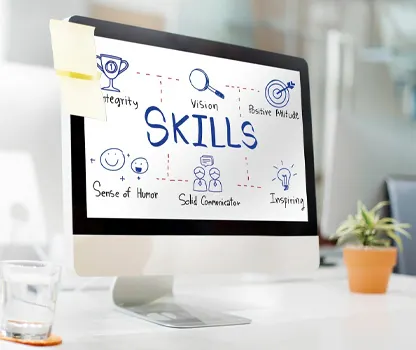
The class studies the topic first, frames the questions it wants answered, and agrees what evidence would count as an answer.
 DRAG
DRAG

 JHS
JHS
JHS
JHS

Jain Heritage School, Bangalore – a group of CBSE and ICSE schools enriched by Finnish pedagogy, nurturing curious, confident and compassionate learners across three Bangalore campuses.


Whitefield: admissions@jainheritageschool.com
Hebbal: info@jhs.ac.in
Electronic City: info@jhselectroniccity.com

Jain Heritage School, Bangalore
At Jain Heritage School, a field trip is part of the timetable – a lesson taught somewhere else. Every visit is chosen by the subject teachers, tied to a unit already being studied, and closed with work that is assessed like any other lesson.
A destination is only useful if the class arrives with a question. Before departure, teachers set the enquiry – a hypothesis to test, a set of observations to gather, an interview to conduct. Learners carry a field journal, with questions ready to answer.
On site, the group works in small teams with a defined brief: measure, sketch, record, question the people who work there. Adults guide gently, so that the noticing stays the child’s own.
Back in school the visit is turned into something: a lab report, a presentation to a younger year group, a photo essay, a model, a debate. That final step is what turns an outing into an education.
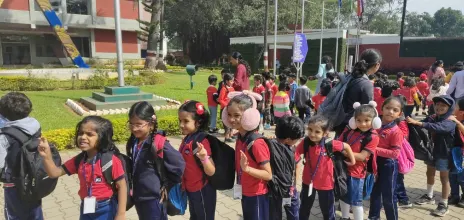
The class studies the topic first, frames the questions it wants answered, and agrees what evidence would count as an answer.
Small teams gather data on site – measurements, sketches, photographs, interviews – each with a named responsibility.
Findings are written up, presented and challenged by peers, then filed as part of the term’s assessed work.
Destinations change each year with the syllabus; the purpose behind them stays the same.
Principles met in a textbook are tested by hand – and the questions that follow usually outlive the visit.
Physics · Chemistry · DesignSpecies counts, water testing and habitat mapping turn ecology into fieldwork with real data.
Biology · Environmental StudiesLearners read objects as evidence, weigh competing accounts, and practise the historian’s habit of asking who is speaking.
History · Social ScienceSoil, seed, harvest and market price – the food system understood from the inside, in conversation with the people who run it.
Geography · SustainabilityScale, distance and time become tangible, and astronomy stops being a chapter and starts being a question.
Physics · MathematicsFactories, newsrooms, courts and municipal offices show senior students how a city works, and where they might fit in it.
Commerce · Careers · Civics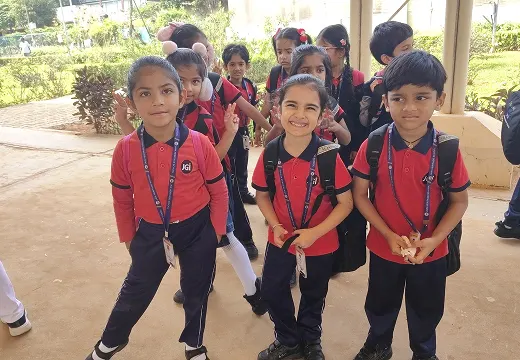
Every destination is inspected in advance, staff-to-student ratios are fixed by age group, transport is vetted and GPS-tracked, a first-aider travels with each party, and parents receive the itinerary, contact numbers and consent forms well before departure. Every child travels with written parental consent.